Showing posts with label grasses. Show all posts

Sunday, June 7, 2015

Next up, mulch.

Two bales of peastraw mulch, and a makeshift curved bench made out of spare recycled red brick (not fixed in place in any way, which is good because I want to tweek it ever so slightly to the left, I expect I'll do that within the next five years or so). 


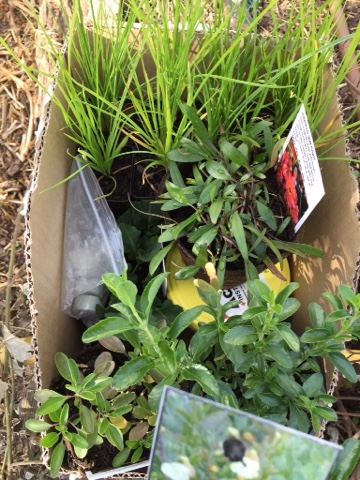
And a box of some of my green recruits.  


I gave up planting after the first four or so plants after my toddler was getting a bit too helpful. Will get back to it later this week, right after I drop of that application to do a degree in visual art (yep, really!). 


Wednesday, October 22, 2014

Golden Celebration

Well, the unexpected 37c October day did frizzle the first flowers on a few roses, but to make up for it my Golden Celebration (David Austin) has really gone to town with the blooms this year! Better late than ever, it had always been somewhat lacklustre before. This is one of the roses i experimentally 'self-pegged' and looks like this was a complete success. I'm super happy with it at the moment! 

[close up]

[effect of pegging the plant]

[GC is still small compared to the surrounding Icebergs, but covered in lovely flowers. Austrostipa mollis grass makes a fabulous airy tall background in the end of day light]

Sunday, October 12, 2014

Four, five, six...

Happy phone-snaps with restless babe on my arm...

Yellow Charles Austin (David Austin, bargain buy).


Strawberry Hill (David Austin).


Can't remember, need to look it up! Yellow English beauty (possibly Moulineux, struck myself from a cutting from my mother-in-law's garden, I think. Why do I not record these things better?!)


Things are really hotting up out there, already the front garden has that dry, glazed, over-bright summer look. 


Saturday, August 17, 2013

Nature strip update

It has been a whole entire year since I last posted anything about my nature strip project! Click here for a picture of what it looked like last time, and for a complete history try here. To refresh your memory (and mine), this council-owned strip of land is hot, windy, very dry, and the 'soil' is compacted clay and dolomite with a roughly neutral pH (despite the dolomite). Before I got my gardener's hands on it, it was a strip of bare gravel with two trees poking out it it (foreground larger tree is Eucalyptus leucoxylon ssp megalocarpa, the large fruited SA blue gum, and the smaller tree further back is probably a weedy malnourished version of the same).
Well, look at this spot now! Starting to come along well and filling out nicely.


When I started I just planted 'native plants,' but after the first round of planting (about three years ago) I've only planted indigenous species in here, and ones I hoped would be suitable (obviously... but I know more now and can choose better!) In this picture there are Poa labilliaderi (most of the grasses), Ficinia nodosa (knobby club rush, bottom right), Acacia myrtifolia (dead centre, still small), Enchalaena tomentosa (left by pole), and Goodenia amplexans (clasping goodenia, at left).


This photo is looking at the same patch from the other direction. At the front-left is a non-indigenous grevillea (name escapes me), at front right is a Myporum parvifolium. Barely visible because it blends in so well, behind the grevillea, is the saltbush Atriplex semibaccata, and behind that is all those mentioned before with a better view of the goodenia (now on the right).


This picture shows the other end of the nature strip. It's a bit more bare because that's where we need to put our waste bins on rubbish days. At the far left is the original Juncus ursitatus (not indigenous), behind that is an indigenous Juncus (sarophus?! C'mon, brain, work!), doing surprisingly well despite the harsh conditions. Also in this picture, but much less obvious, is more Myoporum, Enchaleana, and Ficinia, a couple of eremophilas (cultivars and not indigenous species), a bit of dianella which has been struggling along since the beginning, and a little Calytrix tetragona. And some weeds. Oh yes! I improved the soil and the weeds have certainly taken advantage. Most of them are little thistles and dandelions and easily dealt with. A couple of months ago I also removed the biggest weeds in here: several large clumps of gazanias. 'Oh,' said a neighbour, 'but they grow so well!' Yes, indeed! That's one reason they're a weed!


The one major difference I have found between planting native plants in the nature strip, as opposed to in my front garden (behind the fence) is that the plants are growing far more slowly. This would be from a combination of the difficult growing conditions, and receiving far less water over summer. I only toss a few buckets of water about there when it gets really hot.


 And last but not least, a winter-happy for you :) The indigenous Clematis microphylla growing on my front fence and flowering it's head off. Very pretty!

Stay warm xx


Monday, October 10, 2011

Native grasses

I've been digging holes in the nature strip again, scraping away a thick layer of dolomite and removing it, bucket by bucket, and filling the voids with compost and a fertilizer-free coir peat. Underneath the dolomite is clay. I started my nature strip intervention back in January this year because I was sick of looking at gravel and weedy gazanias. This is what it looked like along our fence when I was partway through replacing the dolomite fill in front of it.


The first thing I did was plant native grasses (Poa poiformis, Blue Tussock Grass) at each fence pillar, and thyme seedlings in between, so that it looked like this:


Then, in March, I started planting native plants into the nature strip by the road. And now, as I get digging again, and thinking more clearly about what I want to do out there, I'm inspired by the P. poiformis grasses by the pillars which are in full tall and swaying bloom at the moment. The thyme plants are getting bigger but are nowhere near filling out the space between the grasses yet. The little natives across the paths aren't doing much just yet, but they've only been in for six months and it's a difficult position. Oh, except for the Juncus ursitatus (Common Rush), bottom right, which is standing straight and proud and filling out at the bottom like a man who's eaten too many donuts. The gazanias will have to go. My neighbour told me they were nice the other day, so she might be a wee bit disappointed when I pull them up, but I did tell her, politely, that they were a 'bit weedy.' For the time being they are only remaining because they stop any other weeds from growing there. Mind you, the only stuff that seems to grow in that dolomite is self-seeded gazanias...


I did go a little bit gung-ho on the nature strip takeover to begin with, and now that I sit back and look at it I'm getting a few more ideas and a little bit more of a clearer picture of what I'd like. From now on, I'm putting in mostly indigenous plants out there (as opposed to just 'native') and I think I'd like lots of grasses in there, and rushes: Baumea, Baloskion, Juncus, Danthonia and Austrostipa. All waving in the breeze at passing cars and a bit ephemeral. And I'd like to plant all those little forgotten understory heathy and shrubby things I love. I already have a few from work, waiting for me to get them into the ground: Astroloma, Scaevola, groundcovering Correa and Myoporum. As much as I am looking forward to our holiday, I almost wish it wasn't in Spring because I want to be out there and digging.