Showing posts with label fruit trees. Show all posts

Saturday, August 24, 2013

Some small progress

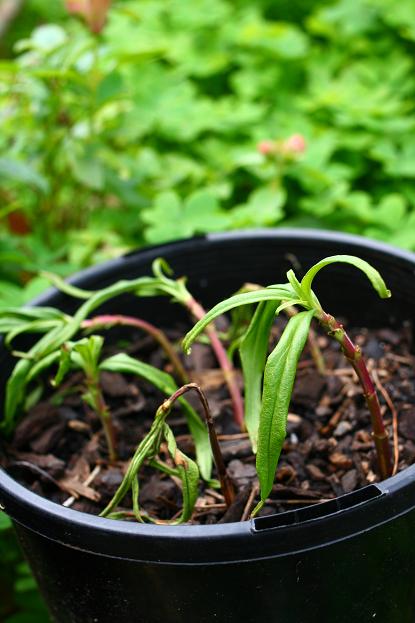
Back in May I did a big overhaul of my poorly kaffir lime tree (clickity click). You know what? It hasn't died! I feel I should celebrate but perhaps I should wait a little longer... But so far so good, anyway. I do hope it starts to do really well after this, once the weather warms up a bit. Kaffir lime is a key component of a number of things we like to cook in this house, and it's a little annoying to have to buy the leaves and fruit every time we need it.

 THEN...
*

NOW!


Meanwhile, I have invested in a miniature cherry tree, 'Cherree Black cherry,' (from Flemings). Gosh, it was expensive! But not much room left out there in the old backyard, and cherries are such a treat it will be worth it.


The backyard is a swamp thanks to all the rain we've had in the last few days. I can hardly wait for spring; less than a fortnight to go! We're making a brief trip to the snow because snow is all Miss 3.5 has been talking about for the last 6 months, and then when we get home it will be all systems go in the garden again.

Wednesday, January 25, 2012

Want to see my vegie garden?

It occurred to me that I've been showing you lots of photos of produce, but nothing to show you where it actually comes from. So today, here is my veggie garden in all it's blazing summer glory. The photos are not fabulous, but that washed out glare is not such an inaccurate representation of mid-summer here in 'Laide. I affectionately call my back garden 'The Shambles,' because it is! One day there'll be proper retaining walls and lawn and so on, but for the time being this is it.

To kick off today's set of terrible photos, I present a Window's Paint diagram of our backyard, next to the latest satellite photo of it. I like to call this one, 'Mama has too much time on her hands.' (Click to zoom so you can actually read the titles!) It's there to give you a rough idea of the layout of the place at the moment.


If you stand on the old patio looking out, this is what you'll see. My patch.


Here near the front is the oldest sowing of baby corn which is running out of steam now, and right in front of that are the eggplants which had the first fruit. The box contains a mostly unsuccessful attempt at sowing carrots when it was much too hot (but it means I have a spare box to fill, woo!) At the very back is my Moorpark apricot, planted in October 2010, which has grown immensely and all of a sudden is taller than I am.


To the left (North) of this bit are my bags of potatoes (behind), and my okra (front).


And behind that, on the patch of ground that will one day be our lawn in between the shed and the water tank, are all of the pots with my little fig trees, citrus, pomegranate, and plums (waiting to go in the ground for our 'real' yard, this winter, maybe?) as well as most of my currant tomatoes, the rhubarb, and a few bigger tomatoes and a variety of randoms like spare strawberries and more beans.


If you step UP the hill here, you'll meet my baby mulberry, look how big he's getting! He was one of my first trees and planted in October 2010.


Behind him, is my fig tree, which whilst not exactly covered in leaves (far from, in fact) is growing us a lovely batch of five figs right now. Yum! This one is a Brown Turkey fig.


Near here are my madly prolific tomatoes (although, slowing down a little now, thank God, was getting very sick of eating them).


And if you stand at the back of the yard, under out half built chicken-coop, this is the view in the other direction. Artichokes blooming in the front, fading sunflowers behind, and just some of the veggie Styrofoam boxes, which currently house a few carrots, the latest batch of bush beans and baby corn, the baby watermelon, the mini-rock melon, and the only successful capsicum bush so far. The tall patch of corn is a mid-season sowing and is just coming into bloom now.


Like these: mini watermelons (well, one!)


And the mini rock melons which are just a little over tennis ball sized.


I also have butternut pumpkins (or butternut squash, as the rest of the world calls it...) scattered throughout the yard in the hope that this year I might actually get one or two of them to eat. This one looks promising...


So that's it (well, not really, just a selection of 'it,' too much and too messy for one post alone.) Next time I'll try a renovation update, since a friend reminded me it's been ages since I've done one, oops!

PS. Just as the tomatoes begin to slow down the zucchinis begin to take over....

Saturday, December 3, 2011

Edibles update (long)

I am making up for a slow posting in November by posting nearly every day in December so far... and I have five more rough drafts full of photos waiting in the wings, too!

So, as you know, we recently spent a month away on holidays and left the garden care (IE watering) to someone else. When we got home the garden was overrun with weedy grasses and thistles, and to my horror a couple of my veggie pots looked like this:


Eek! We'd had an early November heatwave, and some plants got frizzled! For the record, that pot of strawberries and the other heatwave casualties have been lathered with love, water, and Seasol and all are showing signs of recovery, thank heavens! And once I got weeding like a madwoman, the rest of the garden didn't look such a shambles.

But, onto the good news: Tomatoes!
Lots and lots of tomatoes are on their way, and the 'dwarf fig tomato' (Diggers) out the front in my rose garden has a few red fruits already (which I have eaten as I did my rounds deadheading all the icebergs).


Pepinos!
I planted my pepino back in March or thereabouts after buying the plant for $2.50 at a market and having never eaten it before and no idea what it tasted like. I have since seen plants in biggish pots selling for $20, but mine has grown to at least four times the size of a $20 version in about 8 months. I got a bargain! I first noticed the flowers in June, so it has been a long wait over winter and spring for ripened fruits, but now there are flowers on the bush again already. It's quite a low scrambling and floppy shrub, about 1m across, and some of the stems are self-layering along the ground. The leaves are dark green and quite lush and tropical looking in our Adelaide garden. Occasionally something will nibble on the leaves but overall it has been pest and disease free.
The fruit are a muddy yellow colour and striped with mauve, and they don't taste too bad. They're not fabulous, not hugely delicious, but they taste quite a lot like honeydew melon and can be picked and eaten straight off the bush after a quick rinse under the garden tap which is always nice. The skins are edible but a little on the tougher side, but easy to peel, and I haven't found any seeds in any of the fruit yet.


I have loads of plants growing in Styrofoam tubs now, thanks to reading about it on KMKG's blog. The plant at the bottom of this tub is some sort of mini melon, but now I can't remember if it's a Minnesota rock melon, or a Tigger melon. The plant above is... I don't know! It looks kinda like basil, but has no scent so I don't think it's a herb at all. I think it's vegetable that I planted but then forgot to label, as with the melon plants. This tub is a clear demonstration that I must remember to label everything more diligently! I will have to wait and see what I'm growing here, it will be a surprise, I just hope it's not a weed which I'm carefully cultivating in a prime position...
Other herbs, however, like this apple mint are doing brilliantly and are rapidly becoming massive. What's the bet I will regret planting this one directly in the ground? It's in my 'difficult' spot, out in the front garden on the dark south side of the house. Over winter this area gets soggy and almost no sunlight, which I'm hoping will help keep this mint in check.


Unlike the poor potted strawberries above, most of the plants I put out in the front garden are doing very well despite getting minimal water. We get a couple of strawberries a day (so still not the overflowing baskets of berries I dream of), the only issue is trying to get the fruit before the millipedes do.


Still out in the front garden, my new Pineapple quince has seven fruits on it, which leaves me with a dilemma: the tree was only planted over winter (though it is about 6 feet tall). Will it be able to support the fruits? Will they get too heavy and make the slim branches snap? Or will they take too much energy from the baby tree? Should I remove them now, or can I leave them to ripen? Still, one way or another, these fuzzy fruits fill me with joy.


Another delicious 'fruit' I am waiting for is my rhubarb. Also planted in the front garden in amongst the roses, this plant is doing brilliantly and it huge with chunky stems one inch across which I'm eagerly waiting to redden so we can eat it.


Ironically, this teeny tiny unhappy rhubarb is planted only 1m away from the enormous one, and came from the same bag of rootstock! It's so small I had to go poking around in the borage to see if it was still there. Why one plant is 20 times the size of it's brother is a mystery, makes me wonder how different the soil must be even so close by.


Along the fence by the rose garden, facing west, is my banana passionfruit. It was one of the first plants I planted when we bought our house. I have childhood memories of eating these passionfruit when I was a child out of a family-friend's backyard. In the last 18 months it has grown enormously but still not a single flower has ever grown on it. Does anyone have any idea how long a passionfruit vine normally takes to flower? I have read that an excess of nitrogen with inhibit flowering (the vines will make leaves instead), but to be honest I'm a bit slack with fertilizing so I don't know if that is an issue or not.


And lastly, a little promise for the future: the raspberries planted all along the above fence. These babies I dug out of MIL's garden over winter. I had perhaps 10 plants all together. A couple have been lost since I planted them out, but most have survived and while they are small I am hopeful that they will be as wonderful as they are in their 'homeland,' here at MIL's. I don't know what variety they are, but I do know they are delicious.


Happy weekend gardening, all!

Next post: a bit of a floral update.

Sunday, July 31, 2011

Lime time

Today it's glorious outside, it might even be warmer outside than in the house. I can even venture outside barefoot. It's the kind of day where we've opened every window and door to let the sunshine in. It really feels a lot like Spring already. An early Spring? That would be nice, a good way to balance out the early Winter! SP and I made a bit of a tour of MIL's garden, to see what may be seen out there on this radiant July day.

First up, I looked to see how all my propagation of four weeks ago is going. The raspberries I dug up don't look like much from a distance, in fact you could be forgiven for thinking they'd died, but up close their little green noses are poking out of the stems and soil. Yesterday I dug up half a dozen extras, hoping for a raspberry filled Summer;


The white Japanese windflowers are also doing well, as are most of the correas;


But the jury's still out on the penstemons. They're all looking a bit limp and wan;


We cut a whole heap of coriander, and I mean a heap! I chopped it all down and have frozen it in water to use at our leisure. There's still three times this again in the garden;


We found a splash of unexpected brilliance in the red leaves of a rhubarb;


And a sweet surprise from a ground cover pelegonium - or geranium - which has been hiding in the violets and soursobs, I didn't even know she was there until she showed her blushing face;


And lastly we looked at the lemons and limes.


SP helped me collect some of the 'balls,'


So expensive in the shops, and so abundant in MIL's garden! If there were ever fruit trees that paid for themselves in greens and golds, then citrus are it in our Mediterranean climate.


I hope you're all enjoying your Sundays. xx

Tuesday, May 3, 2011

Further to the Persimmon Post

Remember I mentioned that my Fuyu persimmon tree had arrived? He is now in the ground with his own little patch of ground covers.
For this gardening escapade I needed all sorts of paraphernalia. The 'soil' out the front is that dreadful brought in 'garden loam,' which is basically sand tinted brown. Therefore no plant goes in the ground without a generous sprinkling of cow manure, compost, blood and bone, Dynamic Lifter, and a healthy scoop of coir peat for bulk.  


Unfortunately, the first pictures of our persimmon don't look like much. That's because he's just a twig right now. Quite a tall twig, about 3 feet, but still just a twig nevertheless. You can barely even see it against the roses. Originally this section of the garden was white gravel (yuk, hate gravel in a garden! I presume it was put in by previous owners labouring under the misunderstanding that gravel is low maintenance). I've removed the gravel, ripped up the suffocating weed-mat, and pinched some of the bark mulch from under the roses. I'm not big on bark mulch, but since it's there already I'm aiming for continuity.


Around the tree I have planted thyme, oregano, sweetheart strawberries and pansies. There's also Tete-a-tete miniature daffodil bulbs, but we won't see them for a while. It doesn't look like much right now, but give it a few months and we'll see some ground cover action. 


Now, for some time the Iceberg roses have been bugging me. They should be lovely, and indeed the actual flowers are, but they're somehow a bit boring. And I think I've finally figured out why. For starters, I would never have planted roses in a neat grid, but I knew that already. No, it's something else. I've been reading a book called 'Garden Design Details' by Arne Maynard, and there's a whole section in there on vertical elements and I realised that's what's missing from the front garden: there's no variation in height, everything is at the same level.


So, it's not the greatest photo in the world, but you may get a hint of what I'm trying to achieve here. The persimmon will become a small tree, arching up and over the roses to the right and framing the house and garden. Over time I will fill in the garden bed in front of the tree (I have plans!). I might have to bring in more bark mulch even though I don't like it much. I don't think there's going to be quite enough available for continued plundering as I did today.


This is only part one of today's gardening efforts. There will be a sequel later in the week; stay tuned!

Wednesday, April 27, 2011

Persimmons

For weeks persimmons have been tempting me from the supermarket shelves (c'mon, eat us, you know you want to...) but at $2 each they seemed a little extravagant. When we were living in Japan, persimmons ("Kaki") were everywhere; common as muck. They were one of the cheapest fresh fruits available during Autumn and we ate them almost daily. On our train-jaunts about the countryside we would see the trees in people's backyards as we flashed past, heavy with the orange fruits and bright with their flamboyant autumn foliage (contrary to what we Westeners may believe about Japan, quite a lot of people do actually have backyards which fit whole entire trees in them.)

Photo by Diglloyd

Some months ago I ordered some fruit trees from Digger's, and I included a 'Fuyu' persimmon as my nod to our time in Japan. It arrived today in a box on our doorstep, along with a couple of plum trees, a strawberry, a pomegranate, and a white echinacea.
Later this afternoon we stopped at our usual fruit wholesalers, and Behold! Persimmons at $1 each! Seemed like serendipity, so naturally we bought several to celebrate the arrival of our little tree.


Japanese persimmons, Diospyros kaki, are actually originally from China. "Diospyros" means fruit of the Gods, and while I do like them both crunchy and apple-like, and soft and jellyish, I don't think I appreciate them quite as much as the Japanese who make whole hour long TV shows about them, showing the fruit as it advances through it's ripening stages. Non-astringent varieties (like Fuyu) can be eaten when still firm, but the astringent types are very high in tannins when firm so are only to be eaten by daring sorts. It's also attributed with all kinds of healing qualities, but I like it best simply for being a pretty little tree with delicious fruits. Our little tree probably won't bear fruit for several years, but I'm really looking forward to eating our kaki when it does.
(Read more at Wikipedia, if you like).

Monday, September 20, 2010

New Baby

I got a new baby in the post last week, all snuggled into a box and tucked into shredded newspaper, and now she's sitting on my breakfast bar, waiting to be planted. This is my black mulberry tree, and I am ridiculously excited to have one :) Memory here: one of my mum's work colleagues farms on the Eyre Peninsula. It's hot and dry; the family live in a giant tin shed. The adults put down tarpaulins on the ground and shake the mulberries from the tree, which is enormous. We kids gorge ourselves on the dark fruits and run in and out from under the tree's overhanging branches. It's another world under there, cool and dark and light-dappled. Now I have my own treeling, and whilst I don't think I'll let it get to it's potential 10 x 10 meters, it will take it's pride of place in the middle of the lawn.


In other news the air is becoming warm and the garden is blooming. The old rose along the fence, near the letterbox, is shooting into life with pink-blushed leaves. At least one nasturtium has shown it's floral face, and it is a golden yellow with red cheeks, and I have my first correa flower gracing the rose garden.